
When a Client Asks You What They Should Do
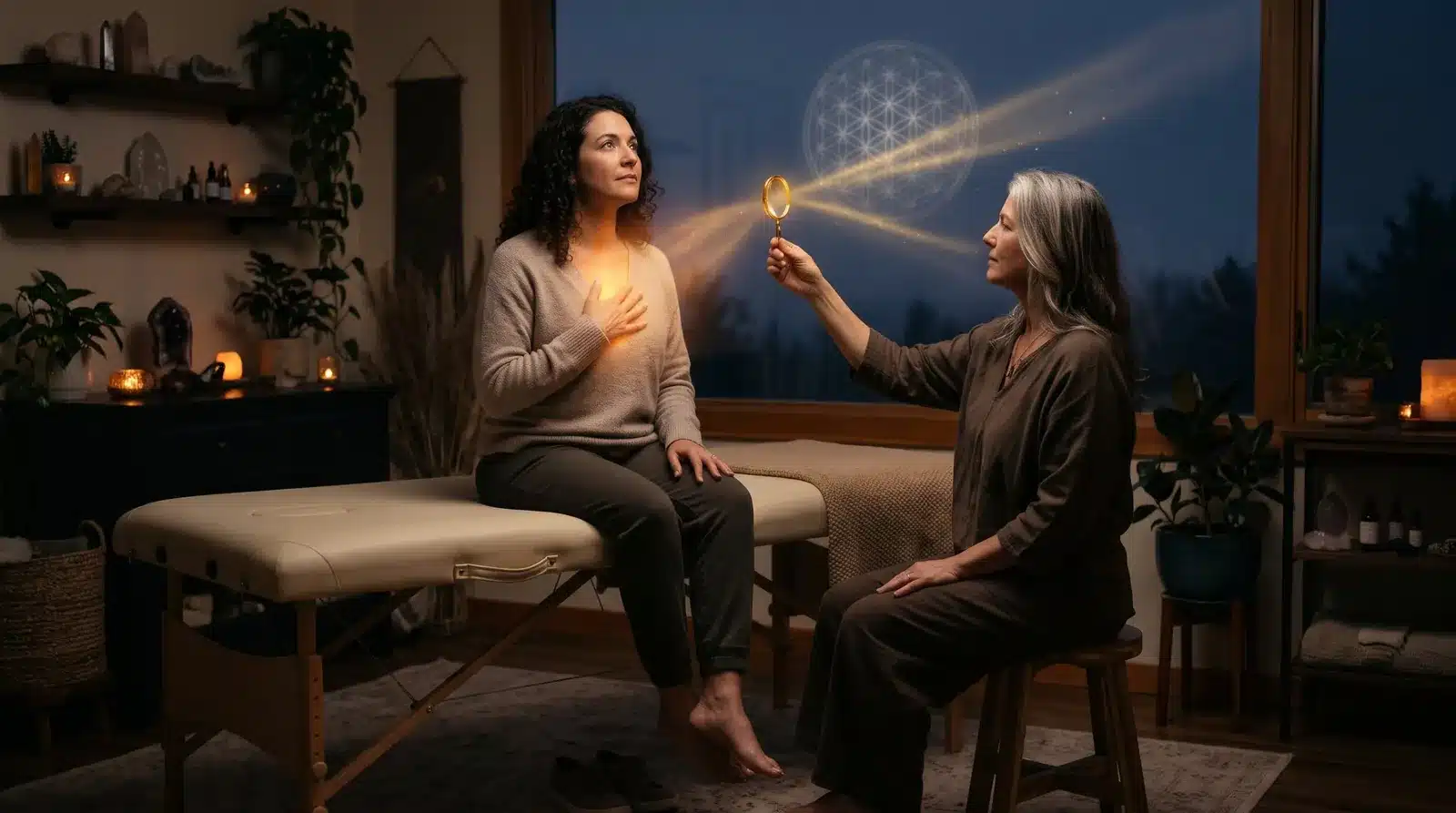
Every energy healer who sees clients for long enough will be asked to make someone else’s decision. It happens most often at the very end of a session, when the room is quiet and the client is still soft from the work. They sit up, reach for their shoes, and ask the question that has been waiting underneath the whole hour. Should I leave him? Should I take the job in Denver? What do your guides say about my mother?
The request carries a great deal of trust. For an hour you have been reading their field, sensing where energy gathers and where it thins, and from where the client is sitting it seems natural that you would also know which way their life should go. Answering can feel like the most generous thing you could offer. The more lasting gift is helping them hear the answer that is already forming inside their own field, so that the choice belongs to the person who will have to live it.
Better One, or Better Two?
If you have ever had your eyes tested, you know the rhythm of it. You sit behind a heavy metal frame while the optometrist clicks one lens into place, then another, and asks, “Better one, or better two?” She has the training, the charts, and the instruments. She can see the curve of your cornea in more detail than you ever will. Still, the choice of lens is left to you, because only your eyes can know which one is clearer. Her skill lives in the order she offers the choices, in the way she slows down when you hesitate, and in the patience to flip back and forth until the letters sharpen. When you walk out, the prescription is precise, and every part of it came from you.
A healing session can work in exactly this way. You may notice that the client’s solar plexus tightens each time the new job comes up, or that their breathing drops lower and slower when they talk about the coast. Those noticings are lenses. You can click them into place and let the client look through them. What they see through each one, and which picture feels clearer, is theirs to say.
What Sits Underneath the Question
Clients who ask for a decision are usually tired of carrying it. A big choice that has been turning over for months becomes heavy, and the loose, open state that follows deep work lowers the guard that usually keeps the weight private. Some clients also grew up in homes where a parent made every important call, and handing the decision to whoever seems wisest in the room is an old and familiar move. Others are frightened of choosing wrongly and would rather someone else hold the risk.
Healers have their own pull toward answering. We came into this work because we want people to suffer less, and a direct answer looks like the fastest way to ease someone’s pain. There is also the quiet pleasure of being needed, and the sense that a good healer ought to know. That sense is closely related to the pattern explored in why healers feel responsible for their clients’ results, where the healer’s care slowly becomes a burden of ownership over someone else’s outcome.
When I teach this part of practitioner training, the question students raise most often is some version of “But what if I can actually see the answer?” It is a fair question, and I take it seriously.
What you perceive in a session is real information. It is also a single hour’s view of a whole life. You see the field on a Tuesday afternoon, while your client wakes up inside that life every morning, knows the children involved, the money, the history, and the hundred small things that never make it onto the table. Your perception becomes far more useful when it is offered as one lens among many. The same care applies when a client wants to know what your guides are saying, and telling guidance apart from your own mind becomes especially important once someone else’s life is resting on the message.
Hand the Lenses Back
A few simple moves let you stay warm and present while keeping the decision where it belongs.
Begin by receiving the question fully. Something like, “That’s a big question, and I can feel how much it matters to you,” lets the client know they have been heard. Rushing past the question can feel like a door closing, even when your intention is kind.
Then offer what you noticed as an observation, with an open hand. “When you spoke about the move, your breath went lower and your shoulders dropped. What do you notice now, as you imagine it?” You are describing what happened in their field and inviting them to look through that lens for themselves. The finer points of how much to share are explored in how much to tell a client about what you sensed, and the same principle holds here. Language that describes keeps the client in the role of the one who knows.
Next, invite the body into the conversation. Ask the client to rest one hand just below the breastbone and hold the first option in mind for a few breaths, then the second. Most people can feel a difference between expansion and contraction, even when their thinking mind has been arguing in circles for weeks. The center beneath that hand has a lot to say about personal will, and why the stomach knots up when you need to take up space offers a deeper look at what lives there.
Finally, give them something to carry home. Suggest they write each option at the top of its own page and read both aloud each morning for three days, noticing which one they find themselves wanting to read first. Decisions often settle in ordinary moments between sessions, and this practice gives the settling a place to happen.
It also helps to name your role before the question ever arrives. In an intake conversation you might say, “In my sessions, decisions stay with the person who will live them. I’ll share what I notice, and you’ll always be the one who chooses.” Said warmly at the beginning, this spares both of you an awkward moment later and tells the client something important about how much you respect them.
When the Question Carries Real Danger
Some questions need a different response. A client who asks whether they should stop taking a prescribed medication needs to hear, clearly and kindly, that this conversation belongs with their doctor. A client who asks whether to leave a relationship and also describes feeling unsafe at home needs to know that specialist support exists, and they may need your help finding it. The signs that a situation has moved beyond what a session can hold are laid out in how to know when a client needs more help than you can give. Pointing someone toward the right door is one of the most caring things a healer can do.
The optometrist’s patience is a good model to keep in mind as you grow your practice. Each time a client leaves your table having found their own answer, a little more of their trust settles in themselves, and that is the kind of change that keeps working long after the session ends. For a free place to begin with the inner side of this work, my guide Awaken Your Inner Healer is waiting for you. For practitioners ready to build these skills in a structured way, with real attention to ethics and the client relationship, the Energy Healer Course goes much further.
I founded the Academy of Energy Healing to train practitioners through IICT-accredited certification courses, and the moment a client asks “What should I do?” remains one of the conversations I return to most often with my students.

Ahtayaa Leigh
Energy Healer & Wisdom Holder
Master Energy Healer, Vibrational Sound Healer, and Esoteric Wisdom Teacher, Ahtayaa founded the IICT-accredited Academy of Energy Healing in 2015, now a premier authority in energy healing certification and transformational energy body activations.
She is the creator of the Golden Ray Initiations, a groundbreaking vibrational healing system expanding the traditional 7-chakra system into the full Rainbow Body energy architecture, guiding you from limitation to wholeness through sacred geometry, light, sound, and profound guided activation.
Her mission is to awaken the full potential of the human soul, individually and collectively, helping thousands around the world experience lasting transformation and a renewed sense of purpose.

Discover Your Soul Mission Archetype
Which Soul Mission Archetype is guiding your path of awakening?
Take the 2-minute quiz to uncover yours and begin understanding your soul’s unique blueprint.


