When Your Client Falls Asleep on the Table: Why It Happens and What to Do
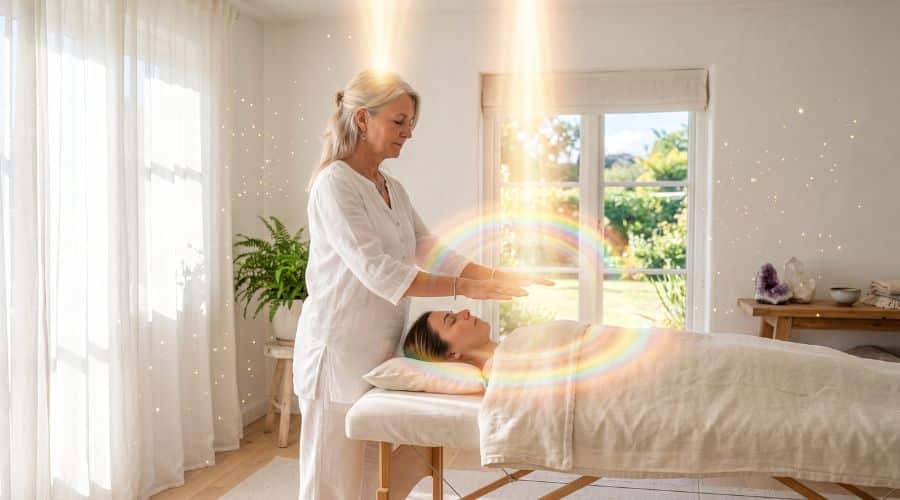
The breathing changes first. It drops from the chest down into the belly and slows, and then, somewhere around the twenty-minute mark, there’s a small catch at the top of an inhale followed by a long, unguarded exhale that tells you your client has gone. Sometimes there’s a snore. Sometimes a hand twitches against the sheet. And in the quiet that follows, a small doubt surfaces that most healers never say out loud, the worry that you just lost them.
If you’re new to practice, that doubt can carry a real sting. The room was prepared, your intention was set, you were fully present, and the person you were working with checked out completely. It can feel like a verdict on the session. I want to offer you a different reading of it, one that took me several years of practice and a good deal of my own time on other people’s tables to trust.
A client falling asleep is very often the session working exactly as it should.
Why the Body Switches Off When the Healing Goes Deep
Consider what has to be true for someone to fall asleep in a room with another person’s hands resting on their shoulders. Their nervous system has to have decided, at a level far below conscious choice, that this place is safe. The vigilant part of the mind that scans every room for threat has stood down. Muscles that hold a low-grade brace all day have let go. The body has a name for this setting: the parasympathetic state, the rest-and-repair mode that only comes fully online once the alarm system is quiet.
The vagus nerve, running from the brainstem down through the throat, heart and gut, is the main channel for that mode, and a great deal of what we do in energy work is support for the vagus nerve and the calm it carries.
Sleep on the table is the visible sign that the switch has flipped all the way over.
Picture a theater at the end of the night. While the audience is seated, the stage crew can do very little. They can dim a light or slide a chair a few inches between scenes, but the heavy work of moving the set, rehanging the backdrop and resetting everything for the next act waits until the house is empty. The moment the last person leaves, the crew comes out and the real changes happen quickly. The conscious mind is that audience. As long as it stays in its seat, watching, commenting, wondering whether anything is happening yet, the deeper work gets done in small, careful increments around it. When it finally leaves the room, the body is free to move the heavy things.
This is why the sessions where clients doze off are so often the ones where they report the biggest shifts a week later: a chronic ache that eased, nights of proper sleep for the first time in months, a conversation they’d been avoiding suddenly feeling possible. What we now understand about how the body actually releases stored trauma points the same way. Deep release happens in states of safety, and there are few states safer than sleep.
I’ve been on the receiving end of this often enough to trust it. Some of the most significant healing sessions of my own life are ones I remember almost nothing of. I lay down, the practitioner’s hands settled somewhere near my head, and the next thing I knew I was being gently told the time. I walked out feeling as though I’d been rearranged from the inside. Nothing about those hours felt wasted, and they changed how I read the same thing in my own clients.
In my sessions now, the people who drop off tend to be the ones who arrived wound tightest, the ones who told me in the first five minutes that they never relax, and I’ve learned to take their sleep as the field’s answer to that.
What to Do While They Sleep, and What to Say When They Wake
Keep working
The work continues whether or not the conscious mind is watching it. Move through the sequence you’d planned, or let your hands follow where the field is drawing you. Healing sent across a distance reaches a person who has no idea it’s happening, and a sleeping client on your table receives in exactly the same way. If anything, the field is more available now than it was ten minutes ago.
Lower your own volume
Slow your movements. Keep your voice, if you use it at all, to a murmur. A person in that state startles easily, and a sudden jolt out of deep rest can undo some of the settling you’ve just supported. If you use chimes, bowls or tuning forks in your sessions, this is the moment for the softest tool on the shelf. The same steady presence that serves you when a client is moving through an emotional release serves you here, in a much quieter key. Tears and sleep are both forms of letting go.
Learn the difference between rest and leaving
One distinction is worth studying closely, because it’s the one that separates a comforting instinct from a trained skill. Restorative sleep has a particular quality. The breath is slow and low, the face is soft, the hands are open, and under your palms there’s a warm heaviness in the limbs. Dissociation, where a person leaves the body rather than settling into it, can look almost identical from across the room and feels quite different under your hands: a cool, thin quality in the field, breath that goes shallow and high rather than slow and deep, a stillness with more holding in it than rest.
If you sense the second, keep your touch firm and grounding, say their name gently, and bring your work down toward the legs and feet. Learning to feel that difference by touch takes supervised practice, and it’s one of the reasons the Energy Healer Course spends as much time on reading a client’s state as it does on technique.
Bring them back slowly
Begin the return well before your time is up. Let more weight settle into your hands, rest a palm on a foot or a shoulder, and say their name once, softly. Then wait. Let them surface on their own timing rather than yours, and give them several minutes longer than usual before they sit up. Water helps. So does a window opened a crack. Close your own field afterward just as you would after any other session; a quiet session still involves an exchange, and the depth of this one can leave you feeling unusually open yourself.
Answer the apology before it lands
Almost every client who falls asleep says the same thing when they open their eyes. I’m so sorry, I missed it. That apology comes from the same place as the doubt that crossed your mind at the twenty-minute mark, the belief that healing needs a conscious witness in order to count. Meet it warmly and directly. Tell them their body dropped into precisely the state where this work goes deepest, and that sleep on the table is about the plainest expression of trust a practitioner ever receives. If they press further, the principle that applies when a client says they felt nothing at all holds here too. What a person consciously experiences in the room is a very small measure of what moved.
Notice the pattern over time
A client who drops off occasionally, or in the deepest part of a session, is showing you their nervous system at work. A client who falls asleep within minutes every single time, and wakes as depleted as they arrived, may be carrying a level of exhaustion or unresolved stress that needs support beyond your table. Keep a note of it. When the pattern is that consistent, it belongs in your after-session conversation, gently, as an observation they can take to their doctor or therapist alongside the work you’re doing together.
So the next time the breathing on your table drops and slows and the small snore arrives, please let the doubt pass through you without settling. Your client is still right there with you. The audience has simply left the theater. Keep your hands steady, keep the lights low, and let the crew do its work.
Ahtayaa Leigh is the founder of the Academy of Energy Healing and trains practitioners worldwide through its internationally accredited energy healing certification courses.

Ahtayaa Leigh
Energy Healer & Wisdom Holder
Master Energy Healer, Vibrational Sound Healer, and Esoteric Wisdom Teacher, Ahtayaa founded the IICT-accredited Academy of Energy Healing in 2015, now a premier authority in energy healing certification and transformational energy body activations.
She is the creator of the Golden Ray Initiations, a groundbreaking vibrational healing system expanding the traditional 7-chakra system into the full Rainbow Body energy architecture, guiding you from limitation to wholeness through sacred geometry, light, sound, and profound guided activation.
Her mission is to awaken the full potential of the human soul, individually and collectively, helping thousands around the world experience lasting transformation and a renewed sense of purpose.

Discover Your Soul Mission Archetype
Which Soul Mission Archetype is guiding your path of awakening?
Take the 2-minute quiz to uncover yours and begin understanding your soul’s unique blueprint.